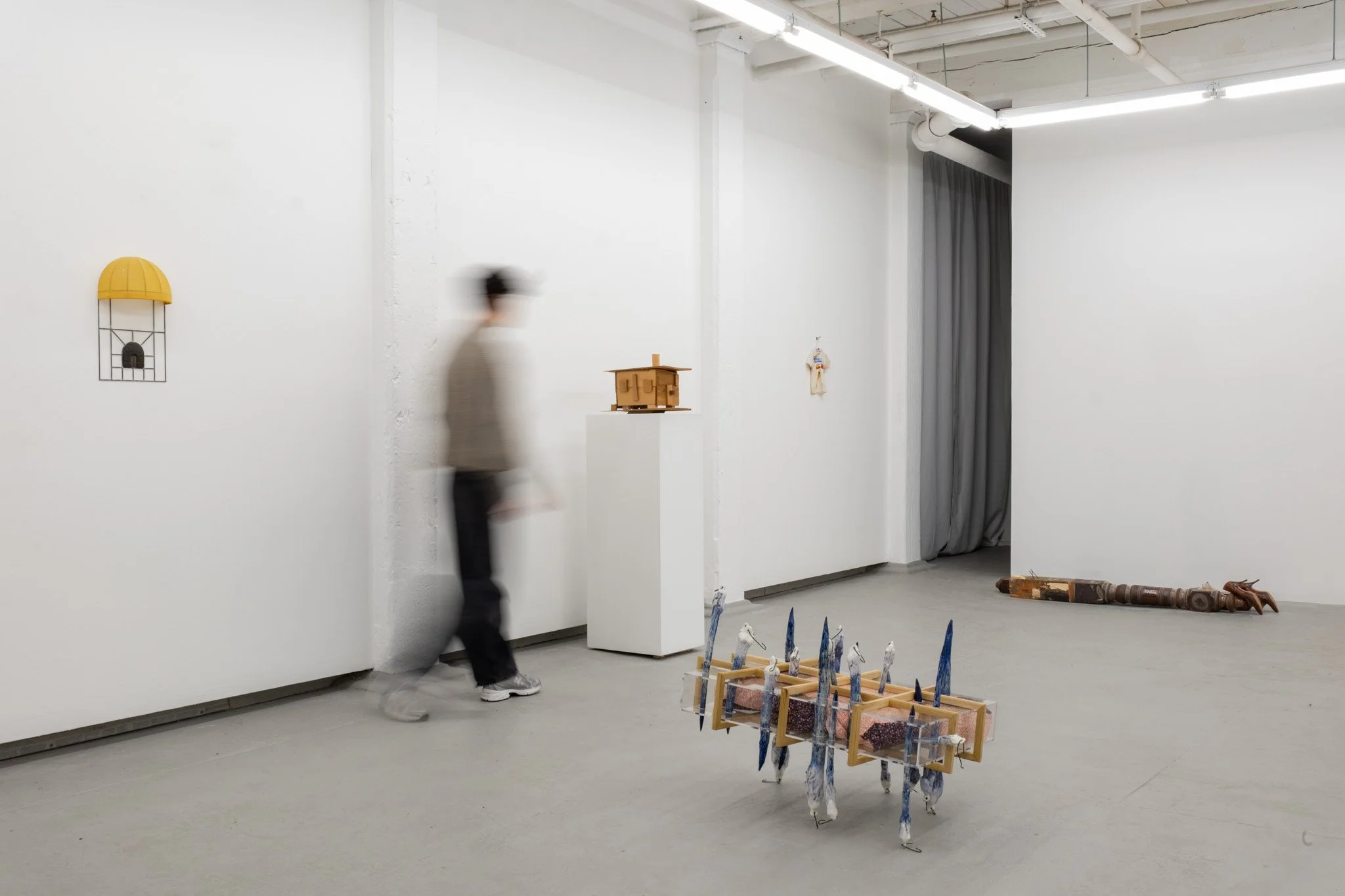
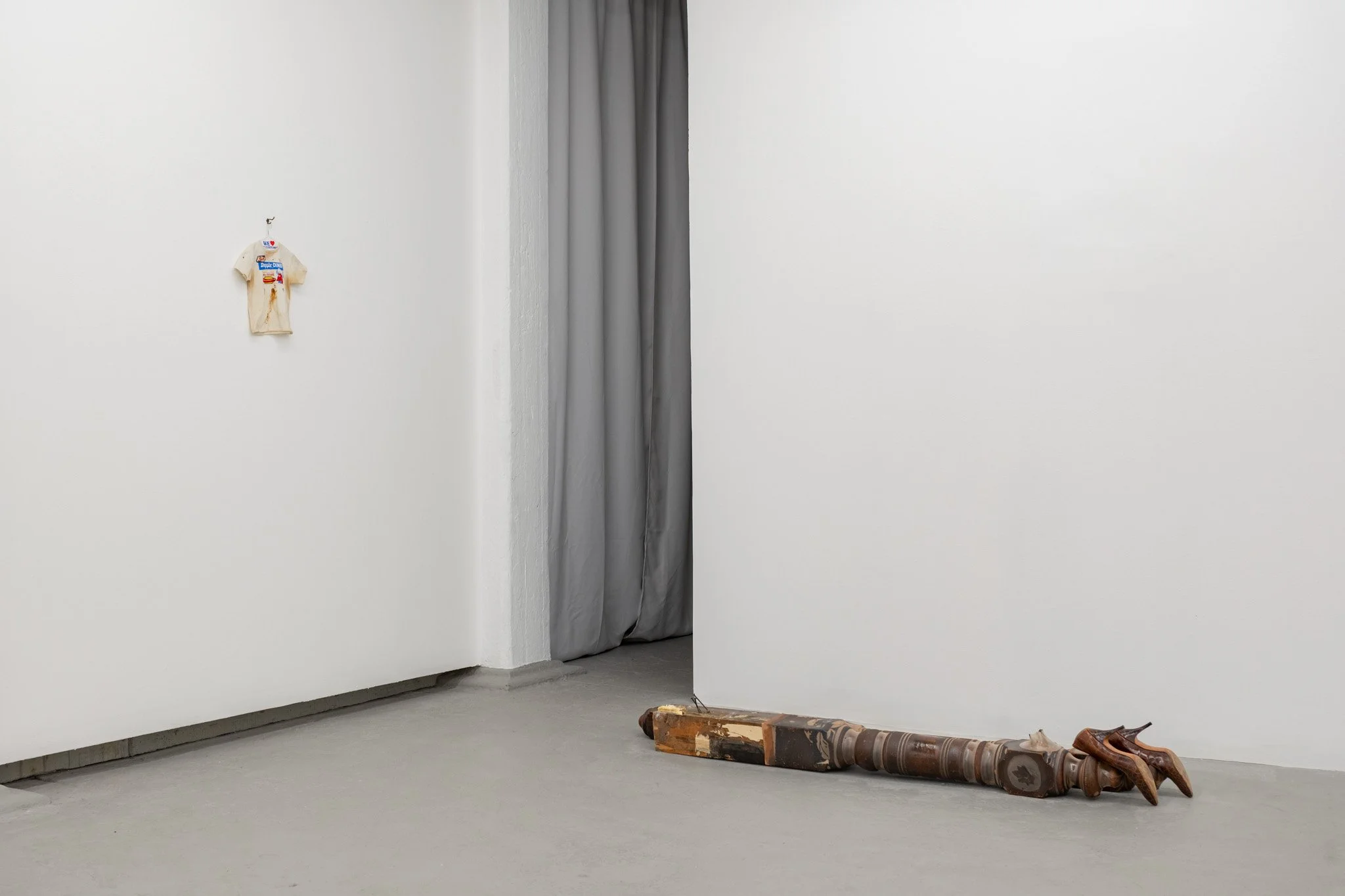
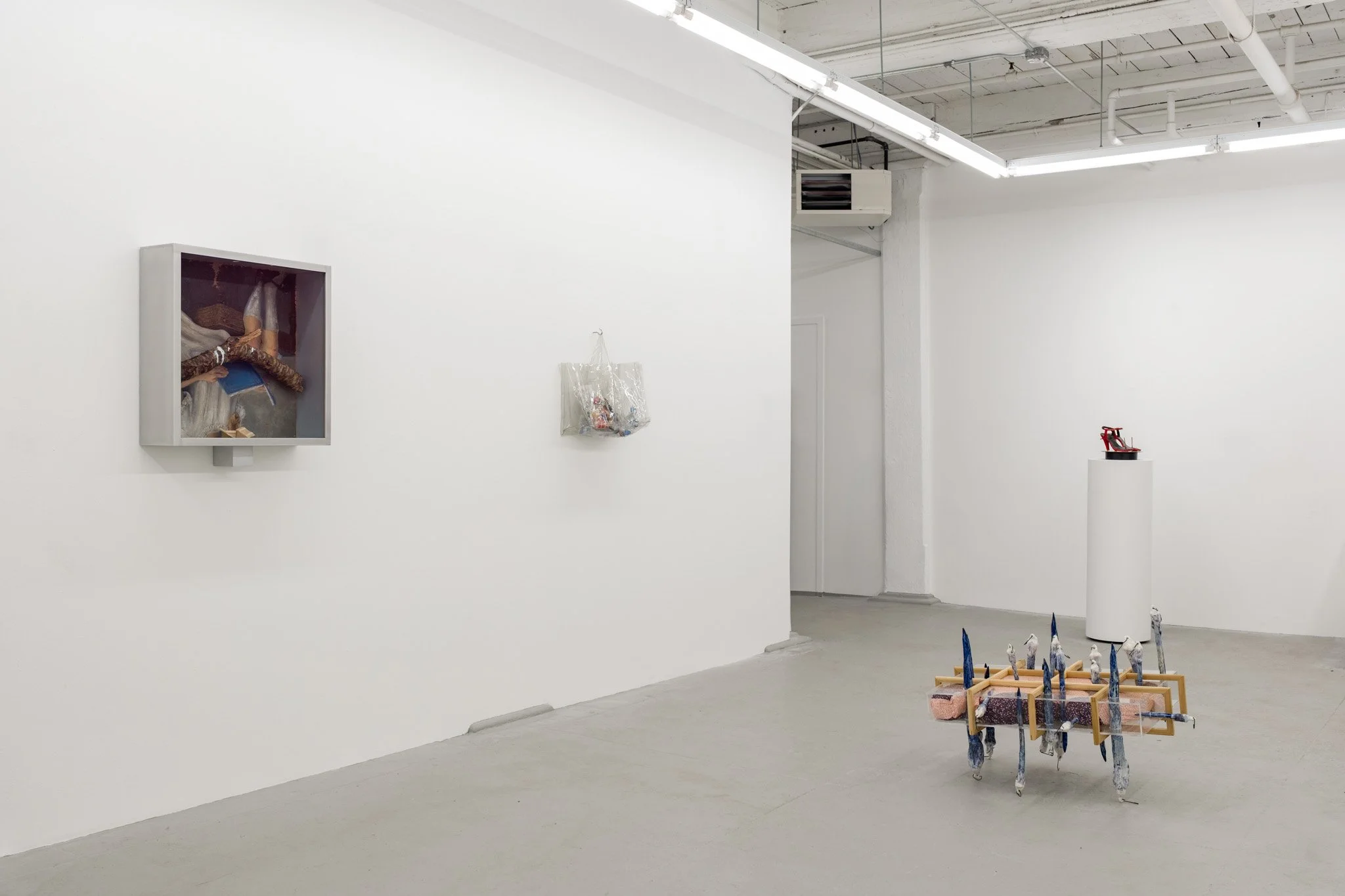
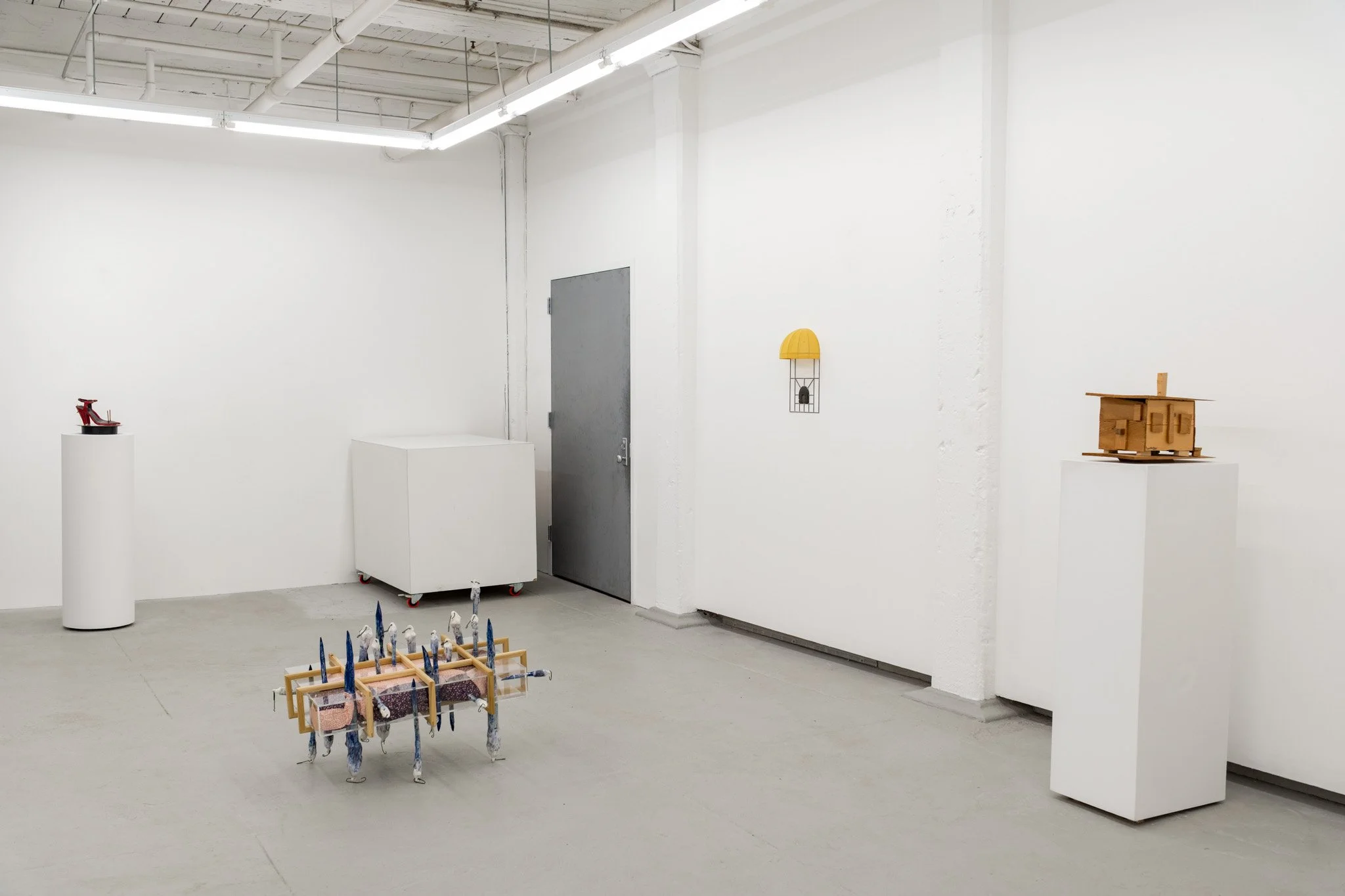
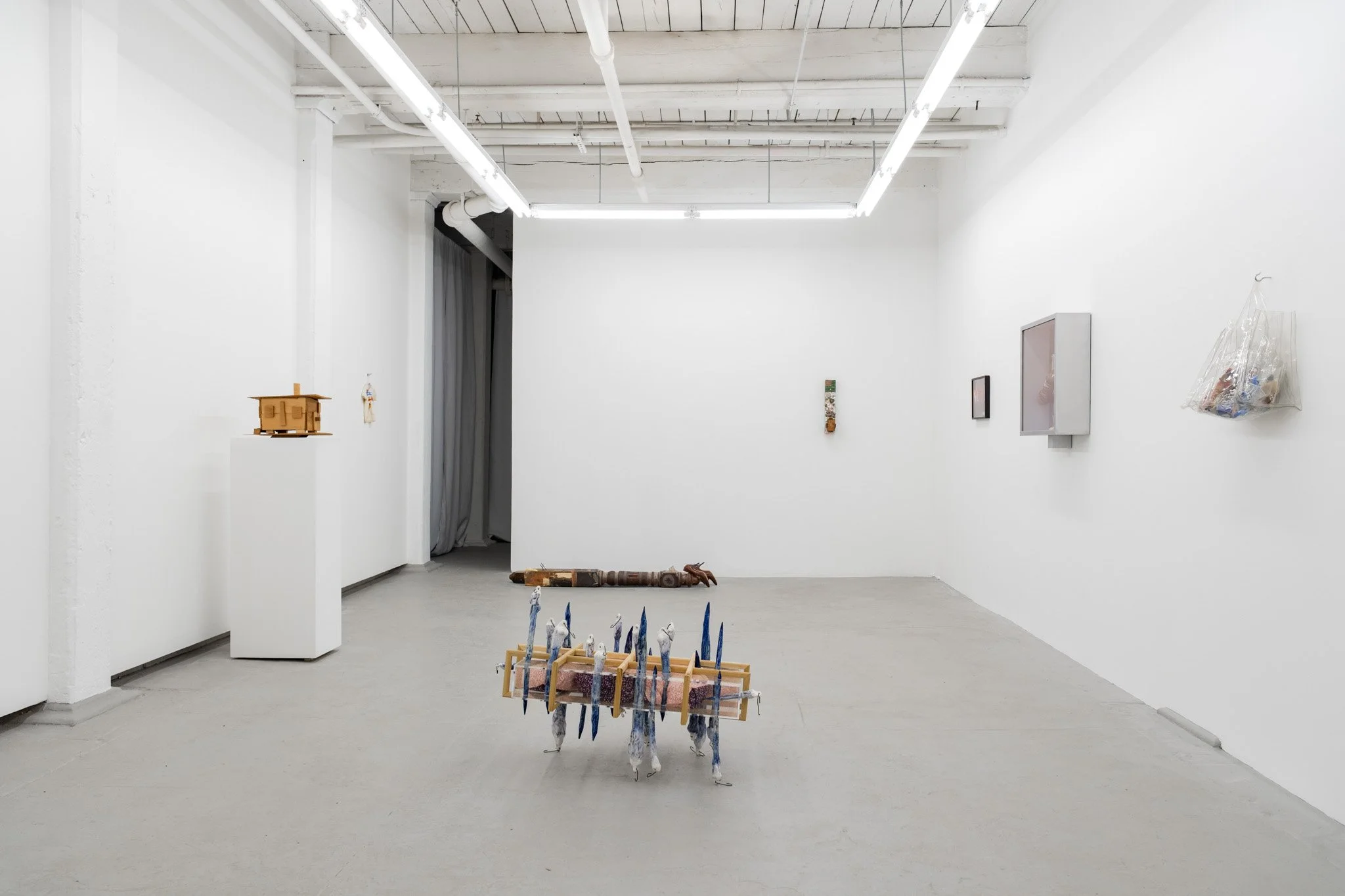
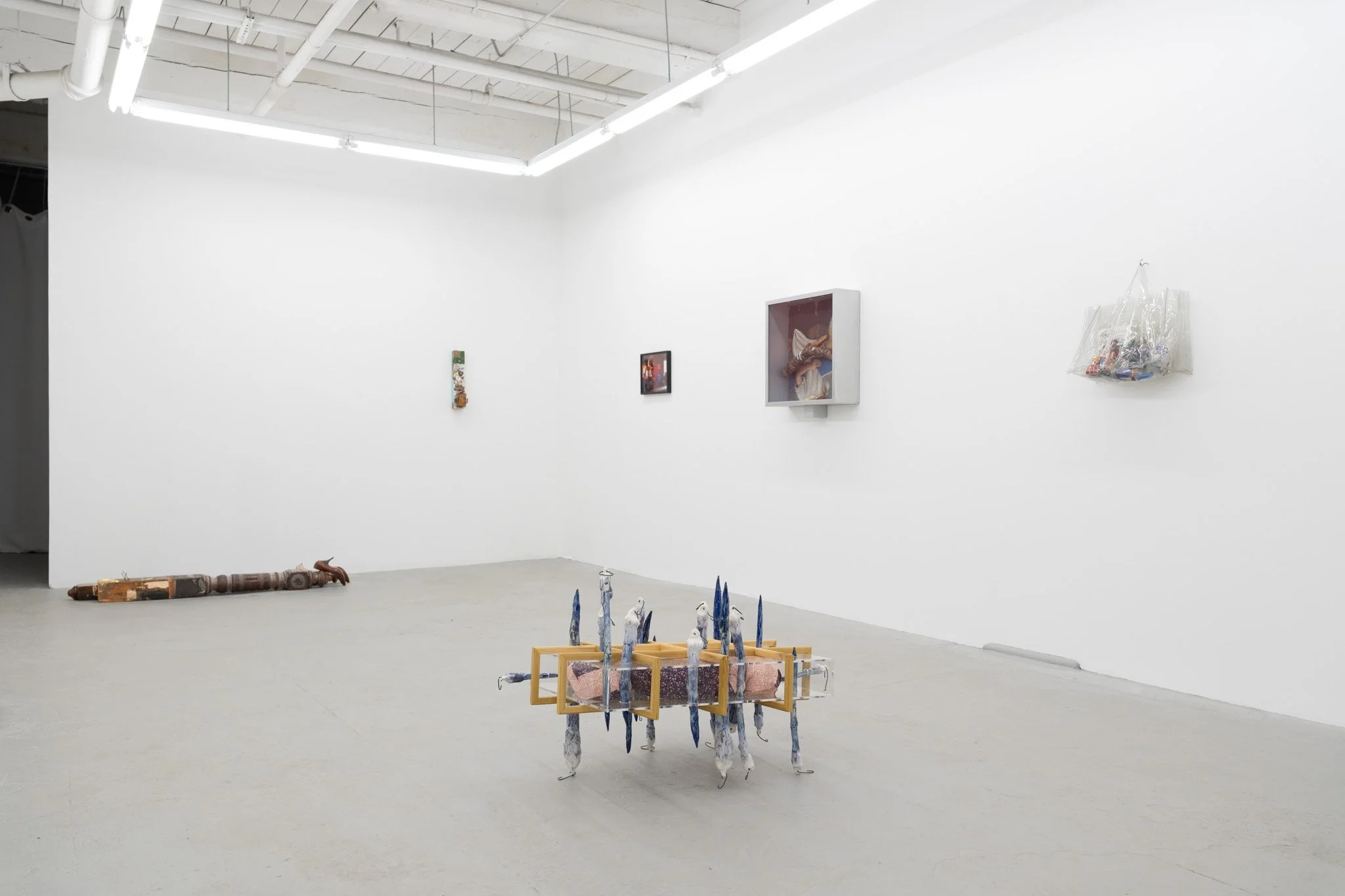
Janet Olivia Henry, Juju Bag for a White Protestant Male (WPM), 1979 - 80, Mixed media, clear vinyl, toys, and dolls, Dimensions Variable.
Photography by Greg Carideo
MAIN GALLERY:
PENUMBRA: BEYOND THE UNCANNY VALLEY
Curated by Austin Johnson and Peter Kelly
March 7 - April 26, 2026
Opening Reception Saturday, March 7th, 2026, 6-8pm
Penumbra: Beyond the Uncanny Valley is an intergenerational exhibition of works by artists creating simulacra of both the human form and domicile—doll and dollhouse. The artists included, while uniquely varied in perspective and approach, all make similar choices in terms of scale, form, and media. The exhibition title references the 1970 musical sexploitation film Beyond the Valley of the Dolls—the official-turned-unofficial surrealist sequel-turned-parody of the iconic 1967 film, The Valley of the Dolls, as well as the penumbra–an astronomical term referring to the partially shaded outer region of a shadow cast by an opaque object.
Artist Mike Kelley was interested in plushies as “the adult’s perfect model of a child,” a characterization echoed by psychologist Ernst Jentsch in his writings on dolls and their roles as vehicles for our collective hopes and anxieties, fears and bizarre emotional projections. Jentsch’s essay The Uncanny was foundational for roboticist Masahiro Mori—who argues that the psychological affinity of humans for inanimate objects which look like them turns to disgust as the resemblance becomes closer. Some artists included in the exhibition appropriate the human form directly—Janet Olivia Henry and Laurie Simmons, works by the majority of the artists featured are notable for their complete absence of the human form. They instead focus on the associated effects of humanity, like empty homes and disembodied apparel. Charles LeDray, Greer Lankton, and Christopher Gambino use clothing, either with a complete absence or an abstracted suggestion of the human form. Greg Carideo, Beverly Buchanan, Robert Gober, Alec Snow, and faith**** use found objects to create sculptures that reference domesticity, while carefully calling attention to the lack of any explicit human presence. On April 5th, artists wei, Allium, and Mason Youngblood will perform a series of sound and performance activations as further meditations on presence and absence.
The penumbra—the visible light surrounding a partial eclipse—aptly characterizes objects associated with but not directly representative of humans. For the purposes of the exhibition’s thesis, this term, typically used in astronomy, posits humanity as an opaque object casting a shadow across the works on display. The vacant contours left behind are open for viewer interpretation and projection. The objects are extensions of the human form, reflecting our bodies but abstracted through layers of reference and recreation–a distance echoed through the exhibition title, between Beyond the Valley of the Dolls and its unofficial namesake.
Jentsch describes the uncanny as “the unsettling ambiguity between the animate and the inanimate.” The exhibition approaches this definition from an alternate angle. How does the suggestion of human form, rather than something that is directly anthropomorphic, expand or even explode this notion? When viewing the unoccupied effects and structures deeply tied to our experience as human beings, do viewers actually encounter the uncanny? The exhibition asks visitors to draw their own conclusions. Are they in Mori’s Uncanny Valley—the Valley of the Dolls—or have they ventured somewhere beyond?
Curator bios:
Peter Kelly is an independent curator, writer, and self-taught artist based in New York City. His focus is on contemporary art–in particular craft traditions, post-minimalism, installation, new media, and spirituality.
Austin Johnson is a musician and independent curator originally from Chicago now based in Greenpoint, Brooklyn. He received a B.A. in Art History from Yale where his scholarship and curatorial work focused on interrogations of colonial practices of the British Empire and Afromodernism. His experience with jazz and electronic music heavily influences his interests in curatorial practices and histories that underscore the contributions of performance art to postmodernism and contemporary decolonizing curatorial practices.