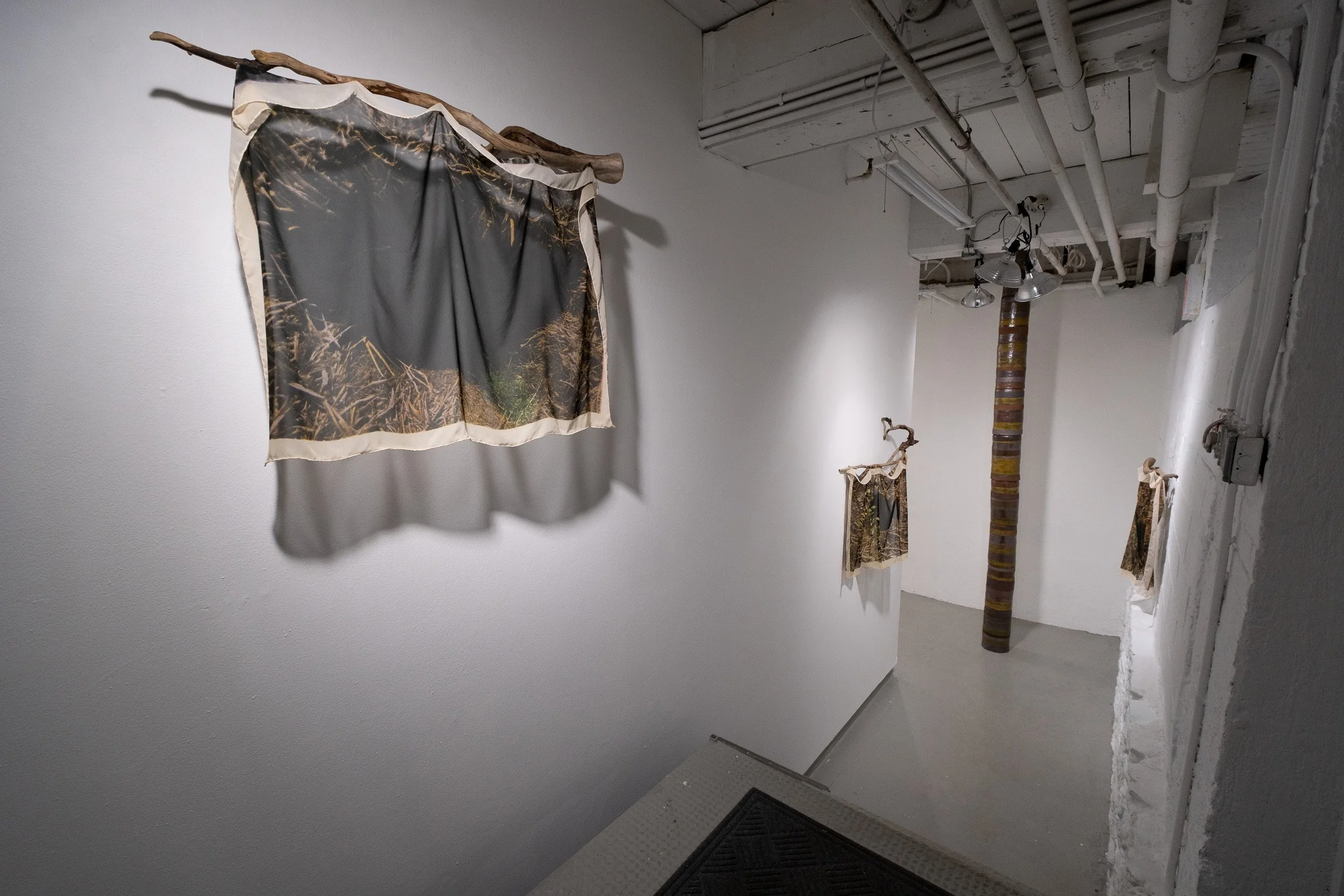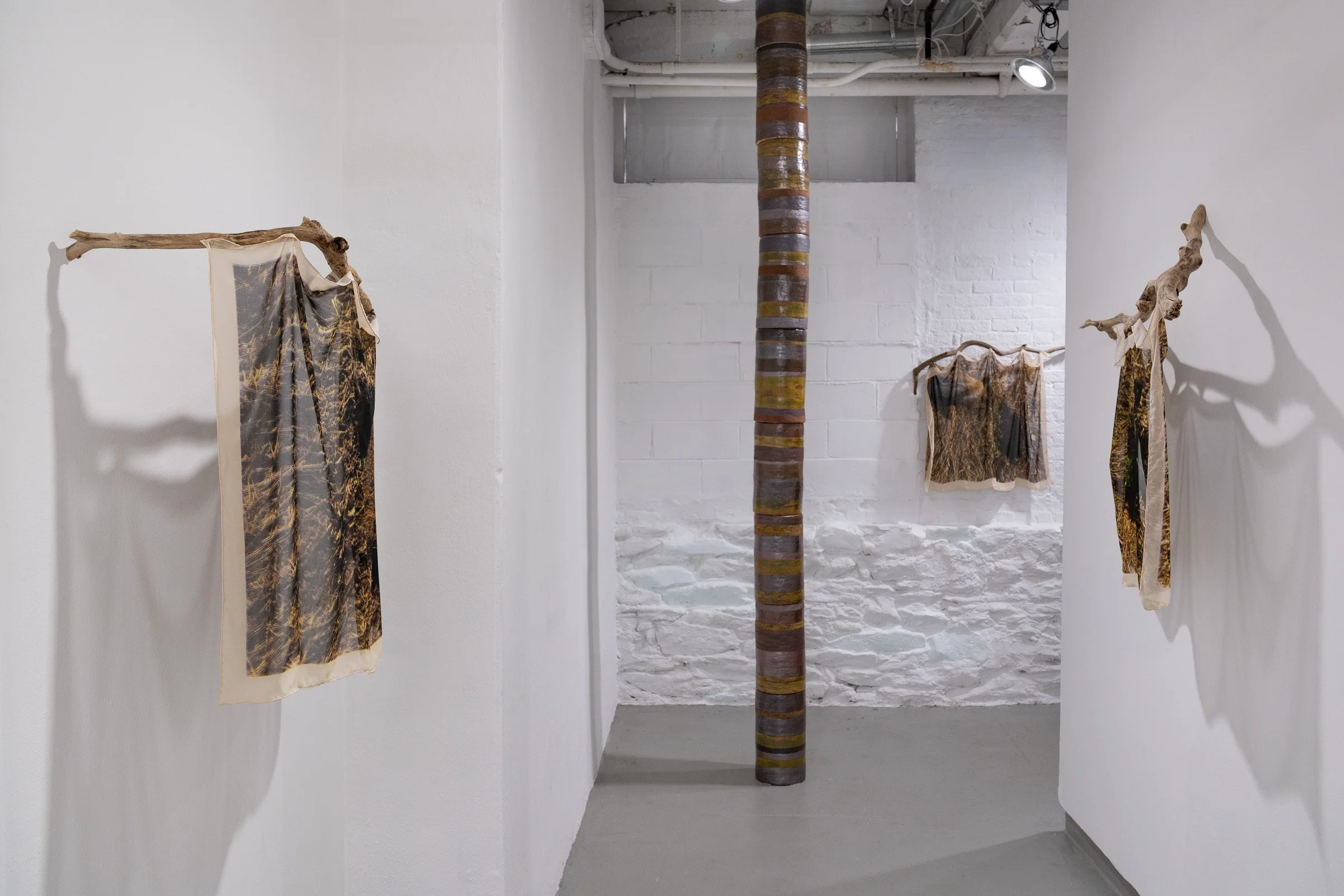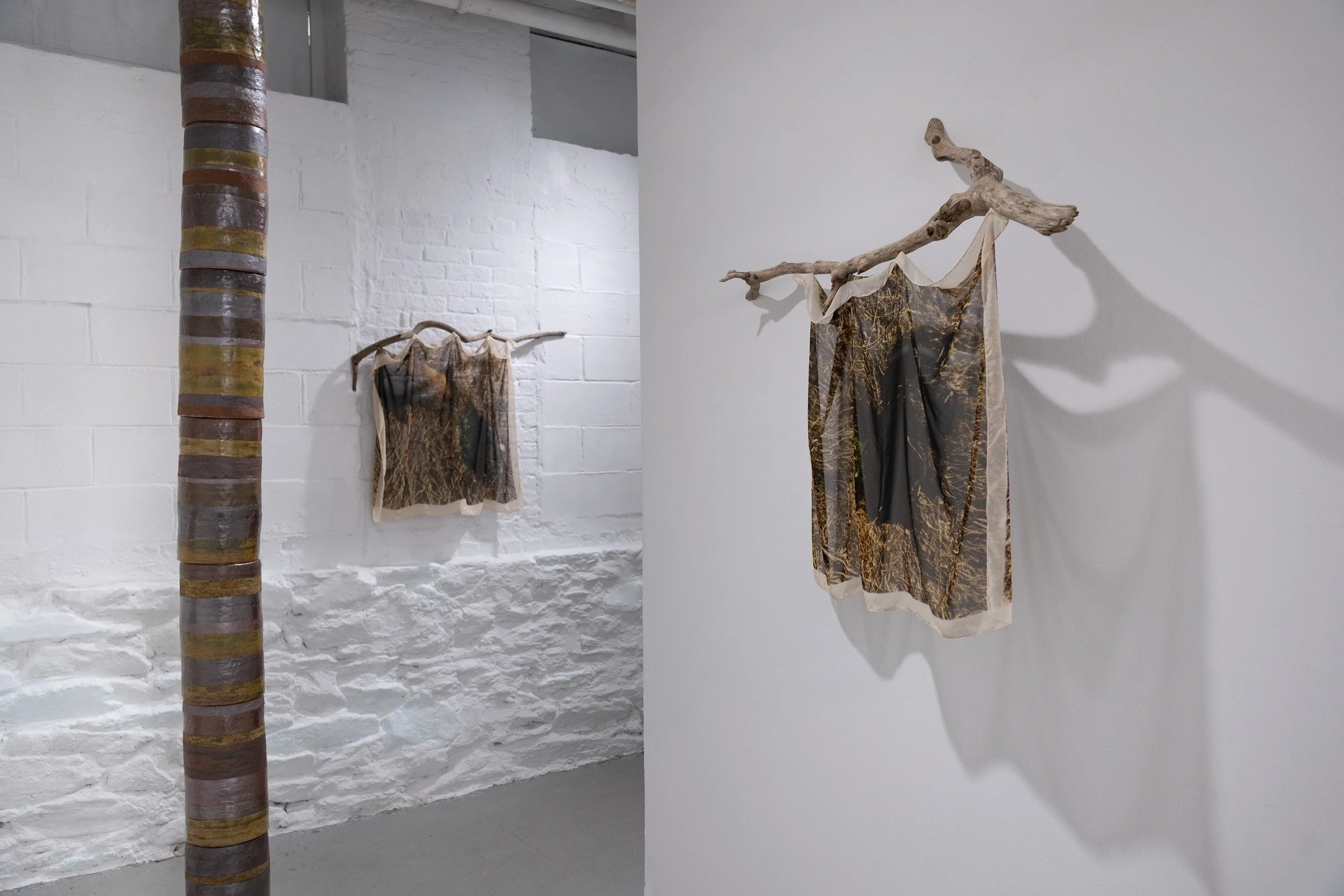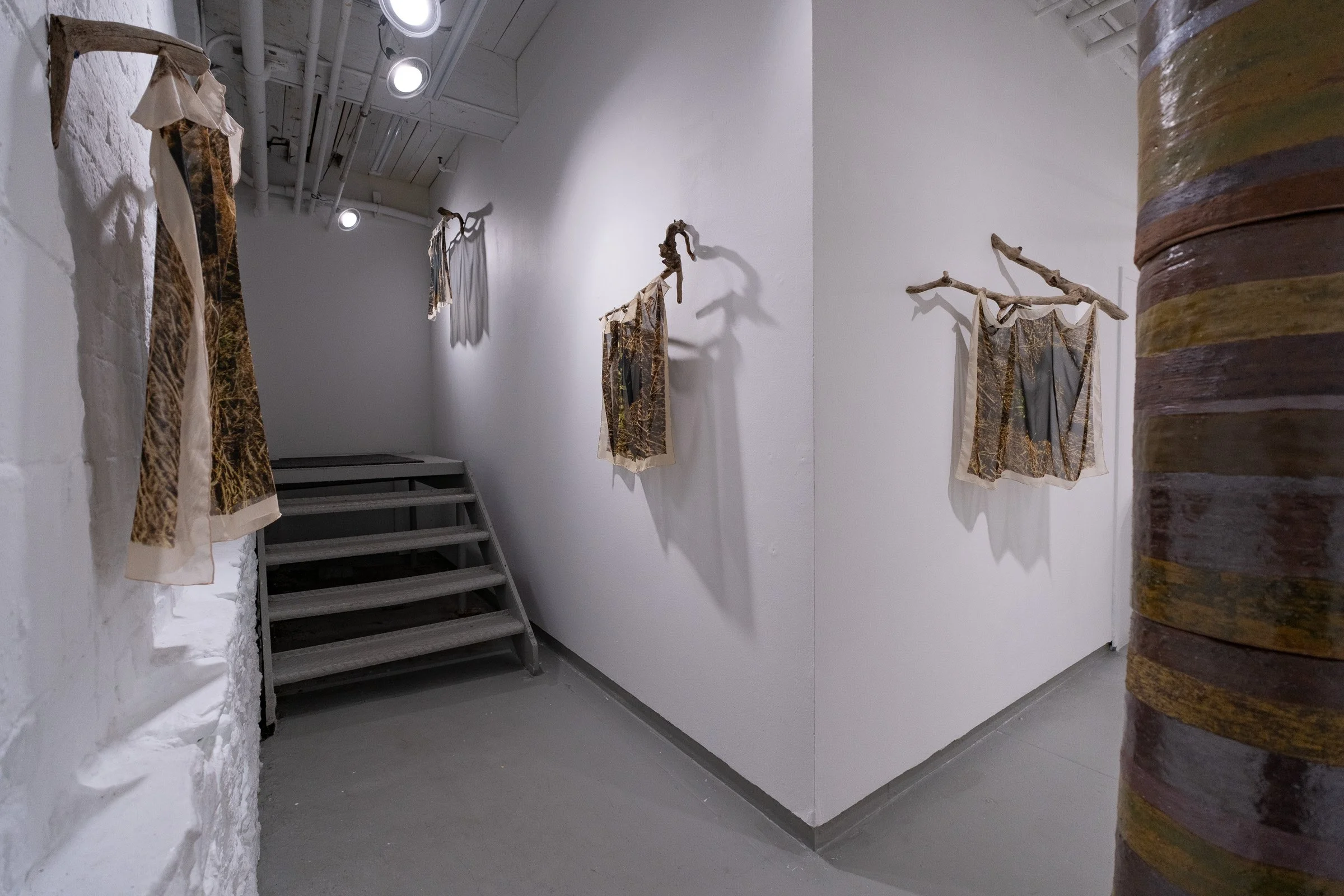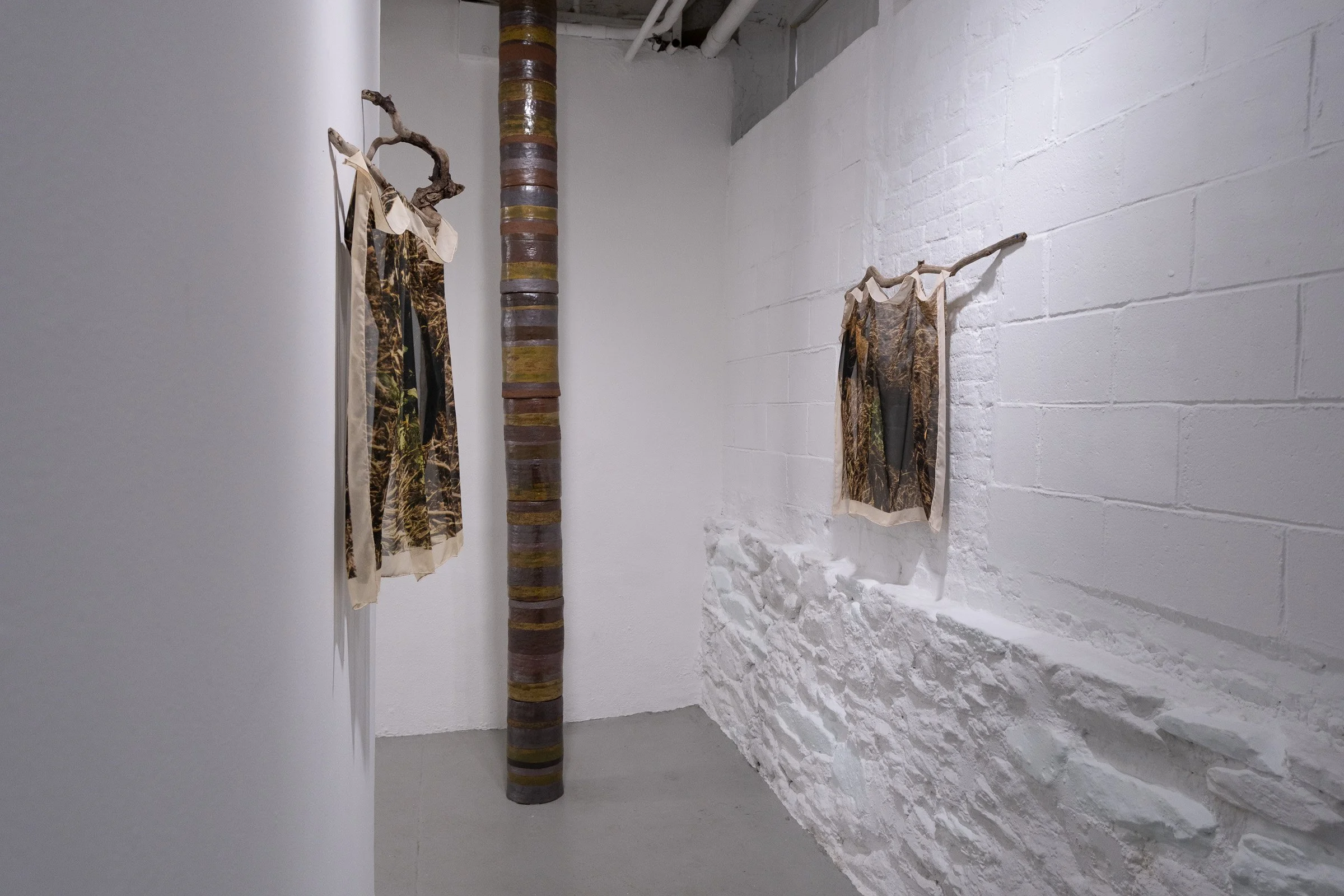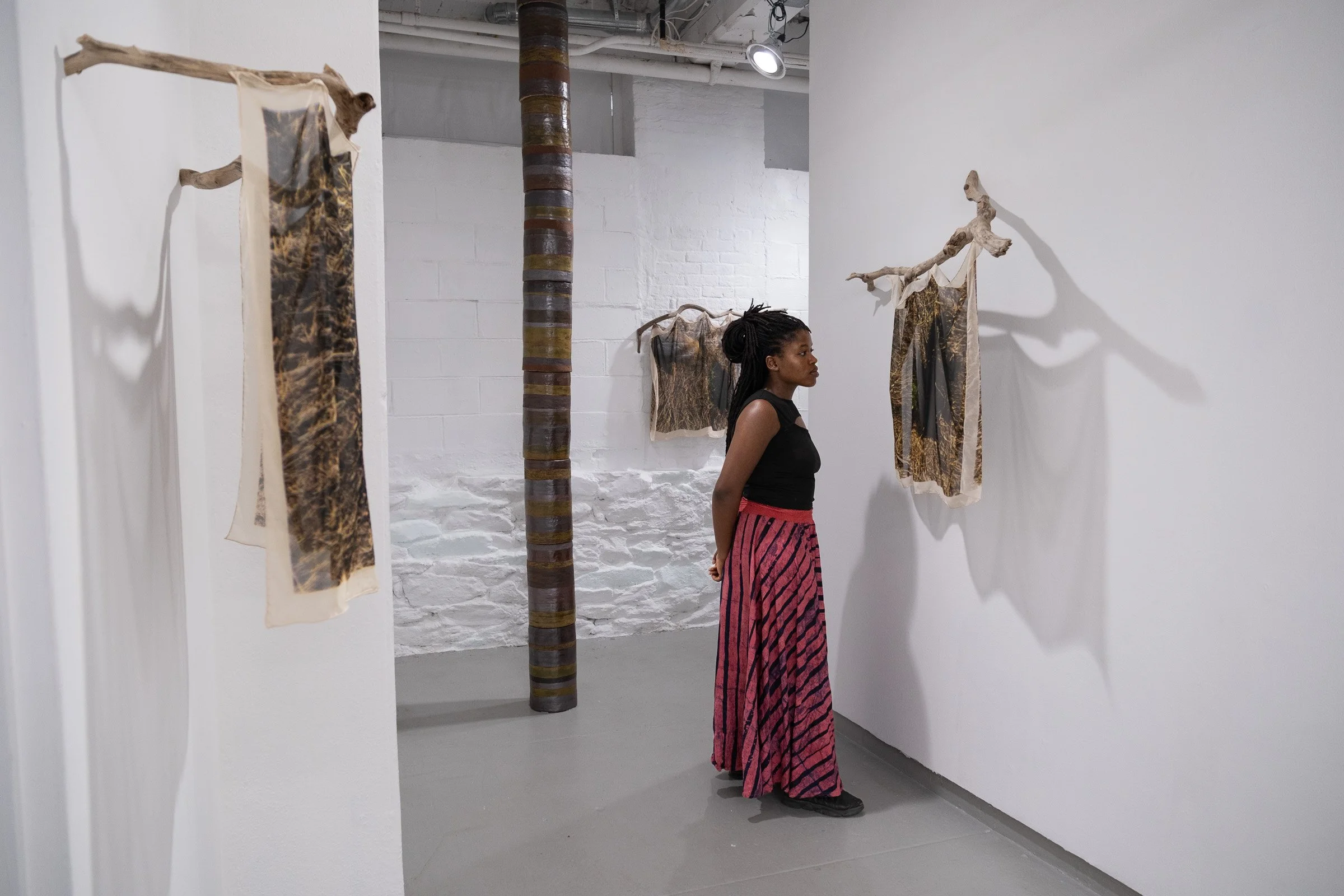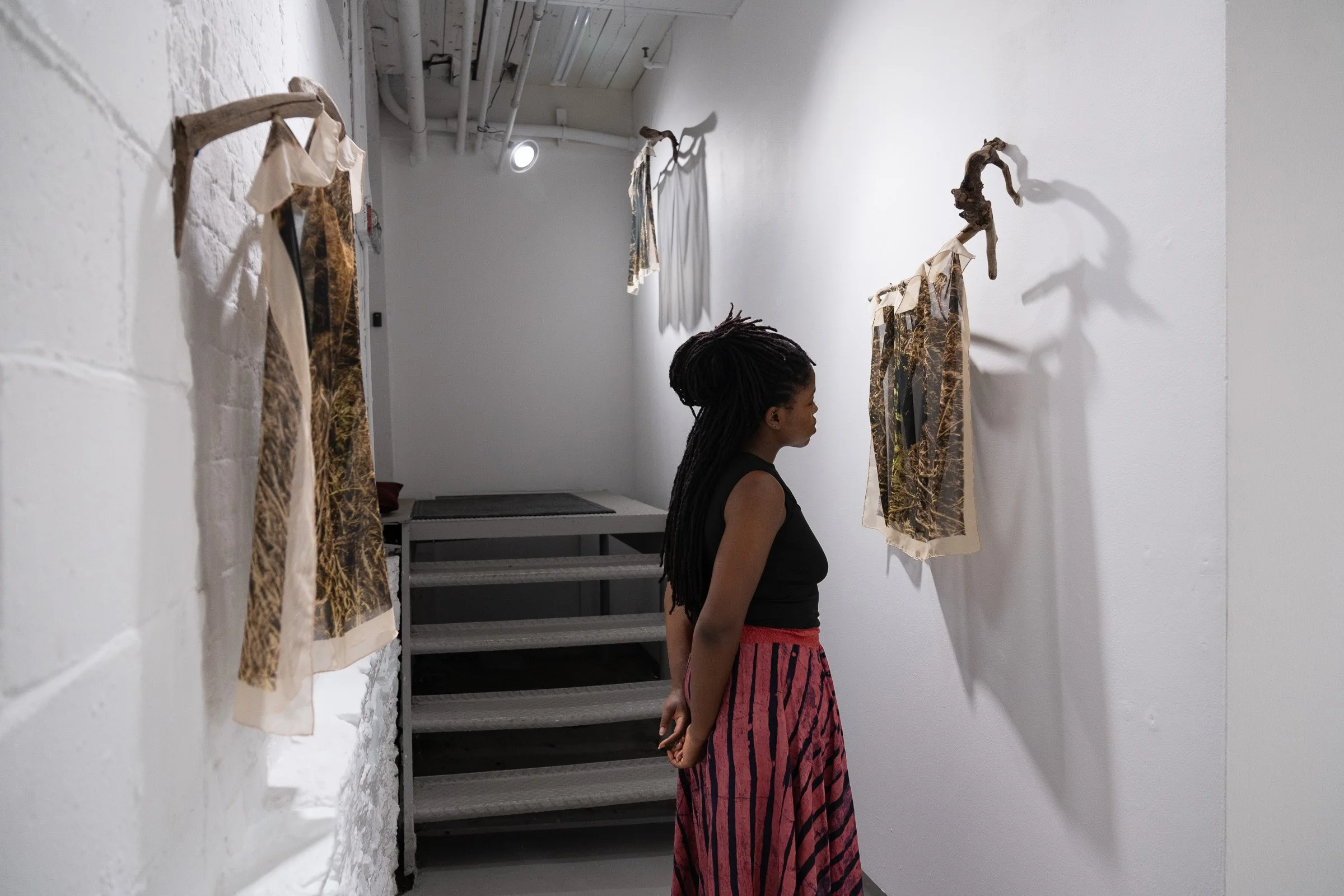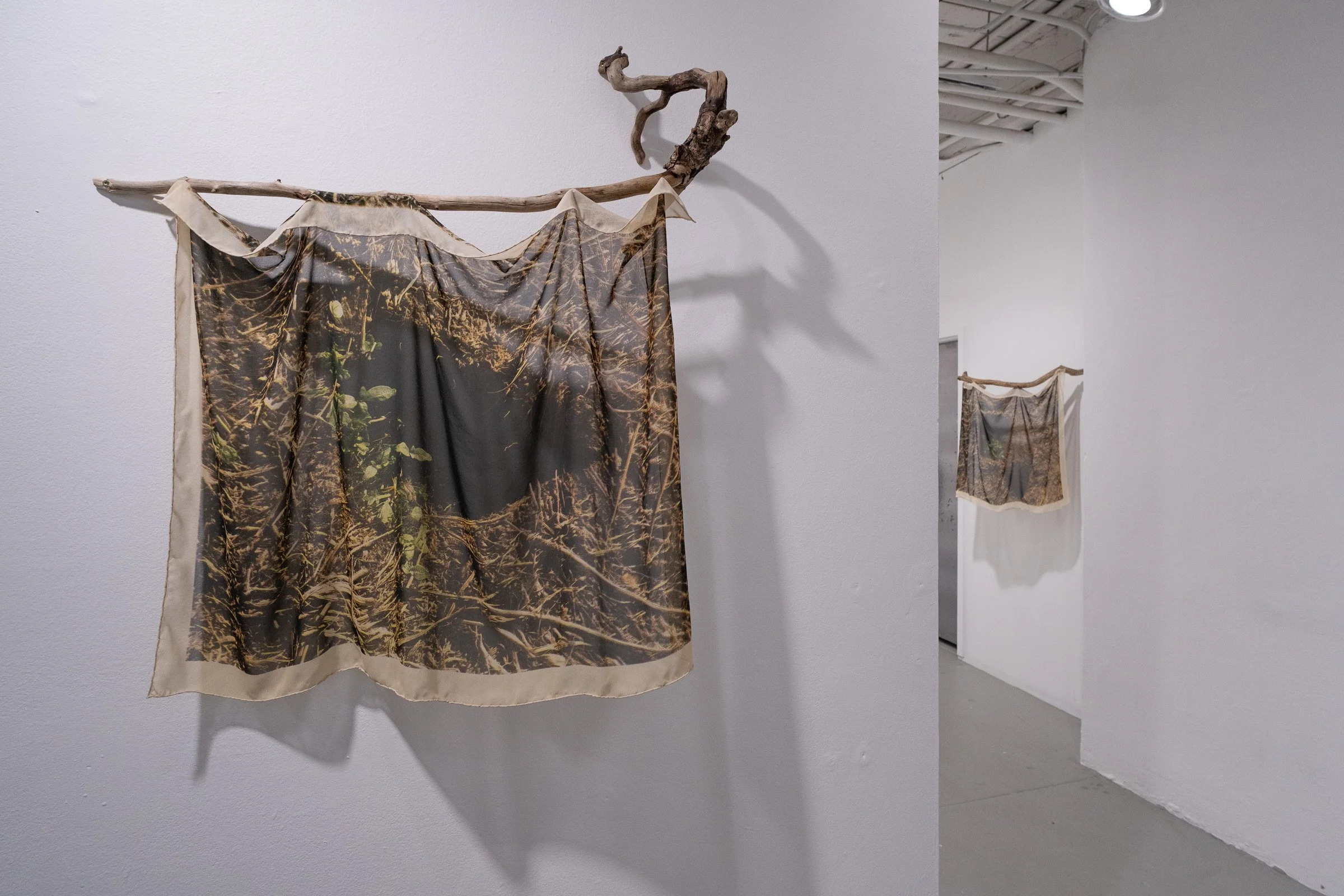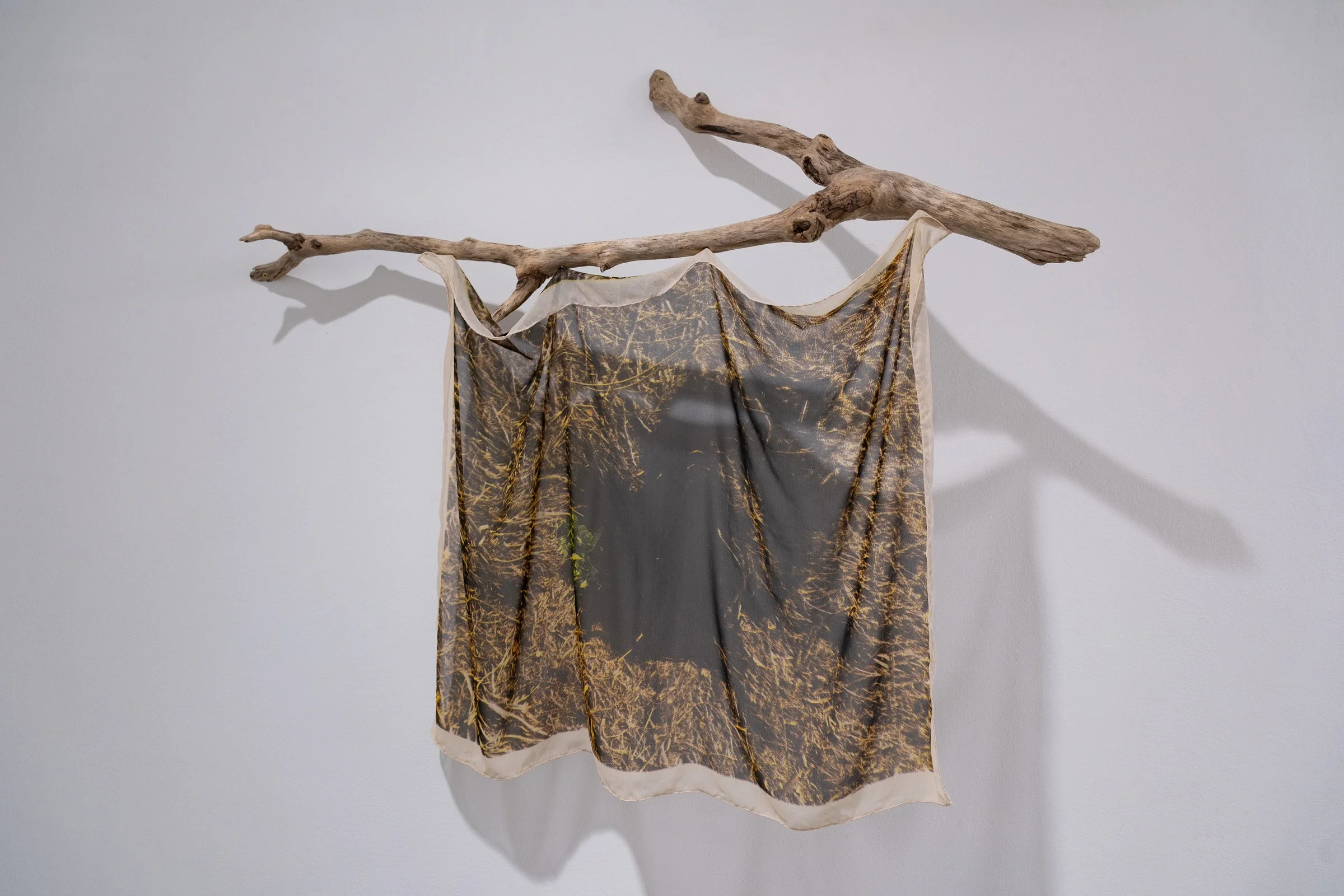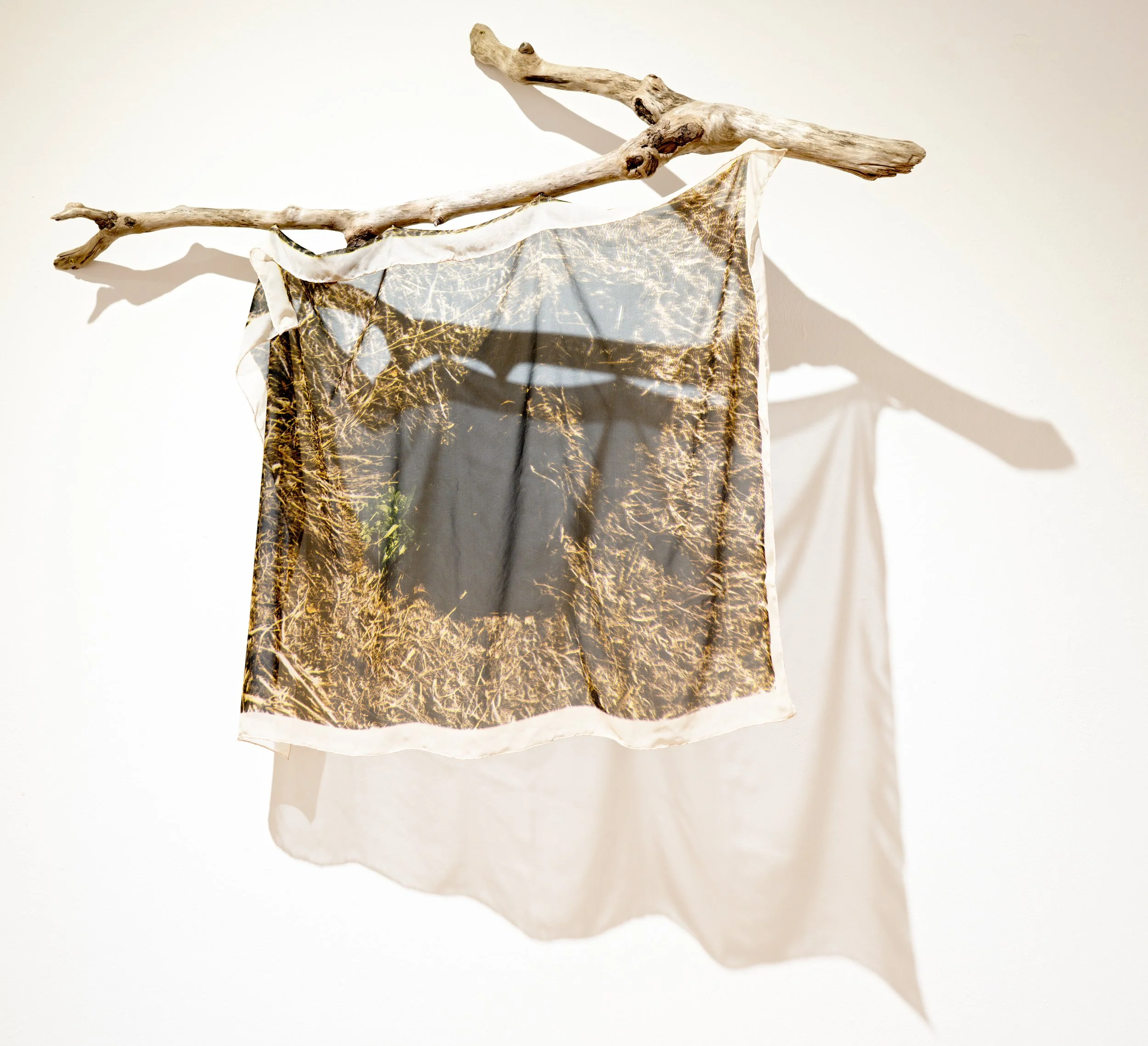
Anna Ialeggio, HOLE FOLDS # 5, 2025, digital print of 4-color Risograph print made from digital snapshots on silk gauze, pine roots, 40” x 30”
The Skirt:
HOLE FOLDS
A SOLO INSTALLATION by ANNA IALEGGIO
Curated by Annamariah Knox and Leeza Meksin
June 12th - August 16, 2026
Opening Reception Friday, June 12h, 2026, 6-8pm
Ortega y Gasset Projects is pleased to present HOLE FOLDS, a site-responsive solo installation in The Skirt by artist Anna Ialeggio, co-curated by Annamariah Knox and Leeza Meksin. The opening reception with the artist will take place on Friday June 12th, 6-8pm, and the exhibition will run through August 16, 2026.
HOLE FOLDS is composed of mediated image sculptures, ceramic objects, and sound. It brings together pieces from three distinct series of work which take contrasting approaches to intimately related subjects and themes: exploration of the personal archive of Ursula K Le Guin (with permission from Le Guin’s estate); long-term involvement in sites of prairie and meadow rehabilitation; the aesthetics and politics of repair as a framework for art-making.
Vesper Meadow in Ashland, Oregon was over-grazed by cattle, clearcut, and drastically eroded along the banks of its streams for many years. Opportunist grass species, most of which were introduced in North America for, or as a direct result of, agricultural purposes, fill the meadows. These grasses (for example, cheatgrass - Bromus tectorum) form thick rhizomatic root mats through which native species have difficulty reaching to the soil below. Even when the grasses have been burned or smothered to begin anew, the root mats remain; other plants cannot thrive there without intervention. One restoration method involves cutting openings down through these dense grassbeds to plant plugs of native grasses. It is a small intervention in the face of a very large problem.
Ialeggio begins with photographs of these intervention sites—fields marked by holes puncturing the invasive growth, taken in a meadow in Oregon. Ialeggio uses an unorthodox combination of printing processes to transform the original image, ultimately fusing them onto fine silk as image-objects mounted on bleached-pine brackets. The series plays with the idea of resolution while maintaining a sense of extreme care, changing images that were once very clear into evanescent, drifting forms.
Other forms in the gallery drift and ground in turn. A ghostly sonic duet with a beloved, deceased author emerges from a monument made from clay-heavy soils. Transformed through heat into a speculative soil horizon, this ceramic monument is intended as its own cut tunnel, through which the viewer might descend down through the accumulated clutter. Perhaps something can grow down there.
HOLE FOLDS proposes a politics of repair that is both optimistic and ambiguous, evoking various idiosyncratic attempts to imagine, excavate, and rehabilitate intimate connection with fragile lands.
--
Artist Bio: Born by the ocean and raised in the mountains, Anna Ialeggio is an educator and interdisciplinary artist living in Downeast Maine. Their work takes a winding path through sculpture, performance and image to consider our collectively fuzzy perception of change. Ialeggio has recently supported by Watershed Center for the Ceramic Arts (2026), The Puffin Foundation (2022), Cornell Council on the Arts (2025), Stone Quarry Hill Art Park (2022), REDCAT Theater (2020), and the Ursula K Le Guin Feminist Science Fiction Fellowship (2022).
While unsuccessful in their audition bid for a salaried role as a charismatic prehistoric quadruped at the Natural History Museum of Los Angeles County, they nonetheless earned an MFA in Sculpture from the University of California, Irvine. Ialeggio serves as Professor of Interdisciplinary Arts at College of the Atlantic (Bar Harbor, ME) and works from afar with The Soil Factory, a communitarian art & sustainability project in Ithaca NY. They feel most alive in their practice when they are working on multiple registers, in multiple modalities, at various levels of formality, and on at least several boats.
Curator Bios:
Annamariah Knox (b. New York City, NY), is an interdisciplinary artist working across textiles, soft sculpture, movement, and video. Her current work integrates videos of body gestures with fabric sculptures to explore the connection to one’s spirit, as it is accessed through the physical body. She received a B.A. in Art History and Theater from Bowdoin College, and a Masters in Fine Art from Cornell University. Recent exhibitions have been at Ortega y Gasset Projects in Brooklyn, NY, at Cornell University, in Ithaca, NY, and at the Soil Factory, in Ithaca, NY. Her show at Ortega y Gasset Projects was listed as a Must See in Artforum. She has been an artist-in-residence at the Soil Factory, Anderson Ranch, and Arrowmont School of Craft. She is currently based in New York City.
Leeza Meksin is an interdisciplinary artist exploring the gendered conventions of architecture, fashion, and the body through the overlap of painting, sculpture, and installation. Her site-specific works, including projects with the deCordova Sculpture Park and Museum, the Brooklyn Academy of Music, National Academy of Design, BRIC Media and UMOCA, deploy fabric as “architectural drag,” temporary, gender-shifting outfits for buildings. This interest in surface and public space derives from a multi-generational family experience of migration, immigration, diaspora, and assimilation. Meksin’s work has been featured in Bomb Magazine, Hyperallergic, Cultured Magazine and the New York Times. In addition to her studio practice, collaboration and curation are central to her creative commitments. In 2013 she co-founded Ortega y Gasset Projects, an artist-run gallery in Brooklyn, NYC, which seeks to advance nonconforming expressions of art as a counterpoint to the industrializing effects of commercialism on cultural production. In 2026 Meksin received the Guggenheim Fellowship in Fine Arts.